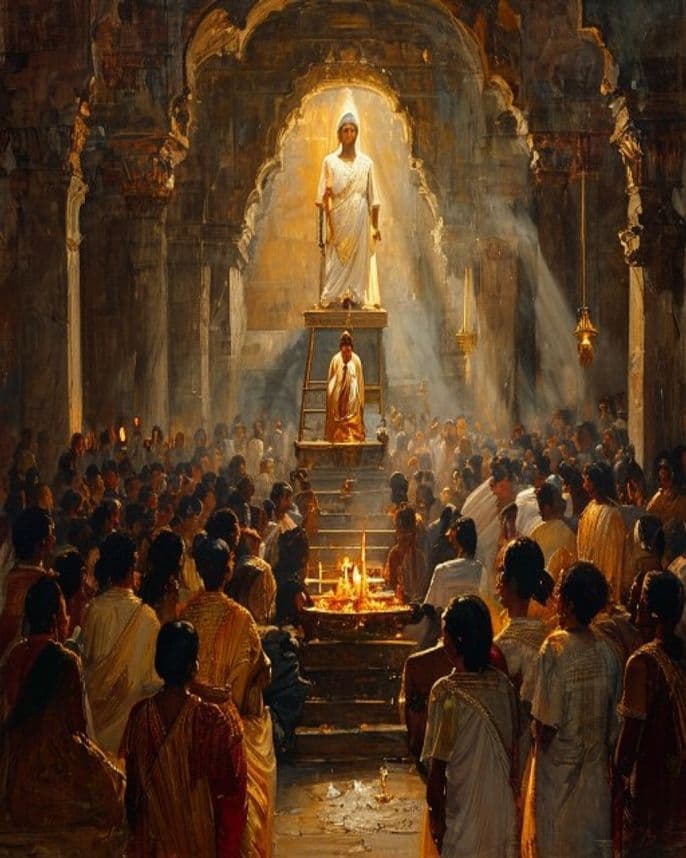
A man who had no business in the church went in to pray on a Friday forenoon, and came out saying he had seen the statue above the altar weep and open her carved hands. This is the whole of what is known about that morning: who was there, what each of them said, who wrote it down and when — and what has never been established.
The morning, in short
The day
Friday, 21 October 1803 — a day that was in fact a Friday
In the Tamil calendar
Aippasi 7, in the year 979 — the one date every source agrees on
The hour
A little after eleven in the forenoon
The place
Before the high altar of the brick church of 1752, where the statue stood in a recess with double doors
Who saw it first
Savarimuthu Pillai, son of Sattiavasagam Pillai — a visitor, up from Tirunelveli
What he said he saw
A cloud, tears, and two hands carved from one piece of wood opening outward
Who else
The catechist Yagappar Pillai, then Miss Henrietta Bilderbeck, then the whole village
First written down
That same day — as a song of five stanzas, by the village schoolmaster
First printed
1905, by a Jesuit of this mission; again in 1914; again in 1930, in Malayalam
During the sixty-three years between the death of Fr Thomassini and the arrival of the new Jesuits in 1838, many interesting events took place but have not come to our knowledge, or have been more or less disfigured by tradition. One however seems to have all guarantees of its authenticity.
Léon Besse, S.J., historian of the Madurai Mission, opening his account of this morning — read here in the parish's own English typescript of his history, page 842. He is hedging everything else in those sixty-three years, and not this
The Story
One morning in Aippasi
What follows is told from the books, in order, with nothing added. Each chapter says underneath it what it rests on and how strong that is — and where two accounts disagree, both are printed and neither is quietly dropped.
01
The years no Jesuit came
In 1773 Pope Clement XIV suppressed the Society of Jesus in every country in the world. The last of the old Jesuit fathers here, Clement Thomassini, died two years later, and for the next sixty-three years no Jesuit served this parish.
It was not abandoned. Priests came from Goa under the Bishop of Cochin, and the roll of them runs without a gap — Deva Varadhanar, Ignatius, John Louis Cardoza and their successors. The feast was kept, the children were baptised, the dead were buried. The village did more than hold on: from about 1780 it became, in the words of a government gazetteer with no interest in flattering it, “the sole centre of the inland mission”, with four divisional centres set under it.
So there was no Jesuit in the district, the see of Cochin stood vacant, and the priest who administered this village came and went. That is the state of things in which the most extraordinary thing that has ever happened here happened.
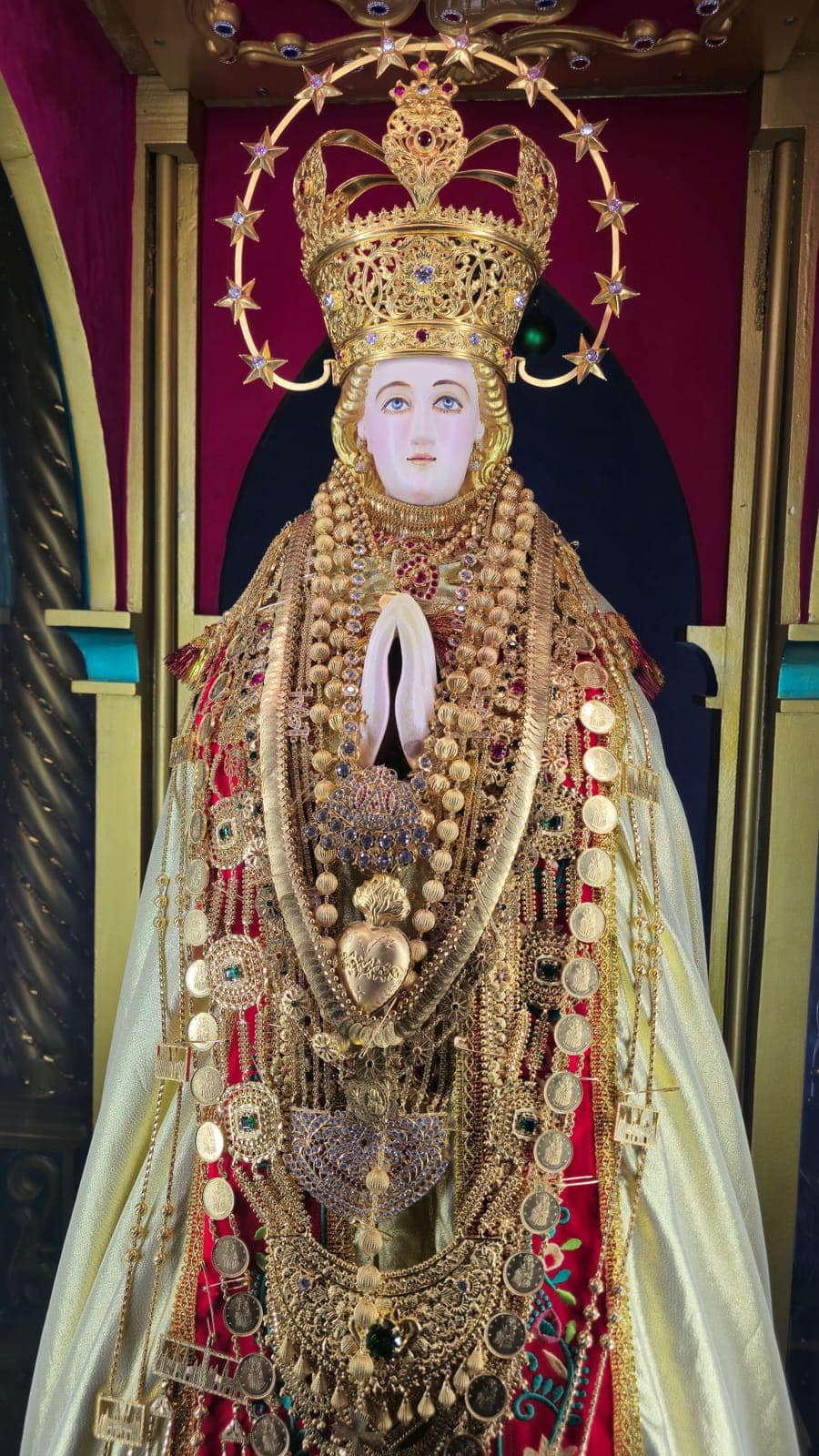
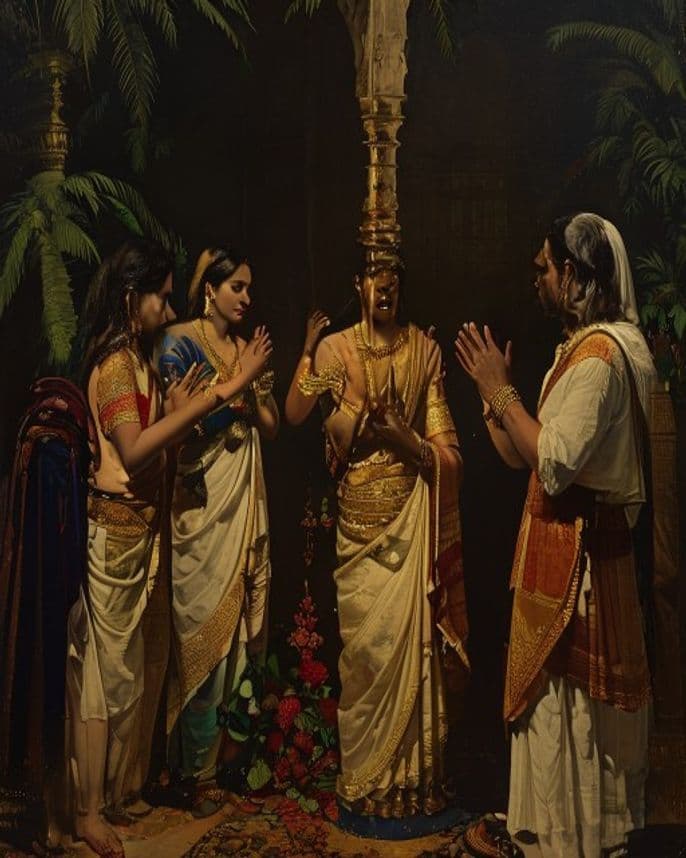
She is carved of wood and she is not large. She stands crowned. Her hands are joined at her breast in prayer, and her arms are carved close against her body — not attached, not hinged, not jointed: cut from the same block.
That is not a devotional description. It is a measurement, taken by the one man on record who ever examined her closely, and printed in 1905: “the arms are firmly fixed to the body; there is nothing pierced through in the joined hands.” A photograph taken in this century shows exactly the same thing.
On that morning she stood above the altar inside a recess closed by a double door that could be opened or shut at will, and both leaves of it were open. Hold on to the hands and the doors. Everything that follows turns on them.
NoteThe Child Jesus seen in modern photographs of her is a separate small figure, set in place when the statue is vested for a feast. The carved image itself has empty joined hands — which is why the 1905 description and the camera agree across a hundred and twenty years.
The parish's own account is this. In 1742 or 1743 a wooden box came ashore on the beach at Koottappuli, down on the Travancore coast, and fishermen found it. Stencilled on the outside were the words “To Vadakankulam, From Portugal.” Inside were three statues of Our Lady. The box was carried up to Fr John Baptist Buttari, the Jesuit of this village — the same priest who would build the church and baptise St Devasahayam Pillai — and he gave one statue to Kamanayakkanpatti, sent one to the bishop, and kept one here.
It is a good story and this parish has told it for a long time. It should be said plainly that it is the parish's own.
NoteNo printed source before the parish's modern chronology carries the box, the sea or the sister statues — not Besse, not Coubé, and not Dessal, whose 1905 description of this statue is the fullest ever printed and who attributes her instead to “a native craftsman”, working in local wood. Kamanayakkanpatti, which is supposed to hold one of the three, tells a quite different story about its own. The tradition is printed here because it is the parish's; the earliest description is printed beside it because it is the earliest.
Every account, in every language, anchors the day the same way: the seventh of Aippasi, in the Tamil year 979, a Friday. The twenty-first of October 1803 was a Friday.
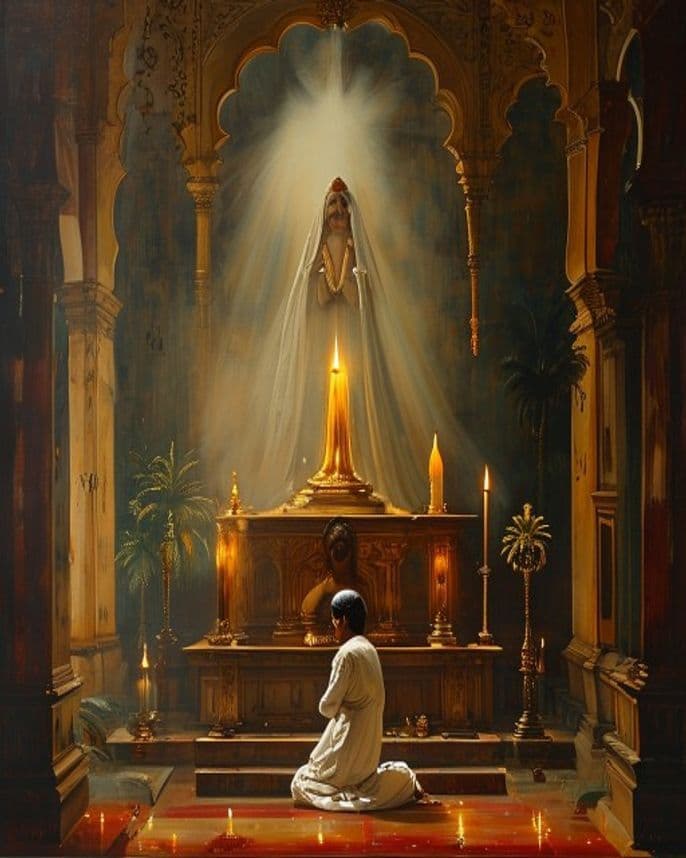
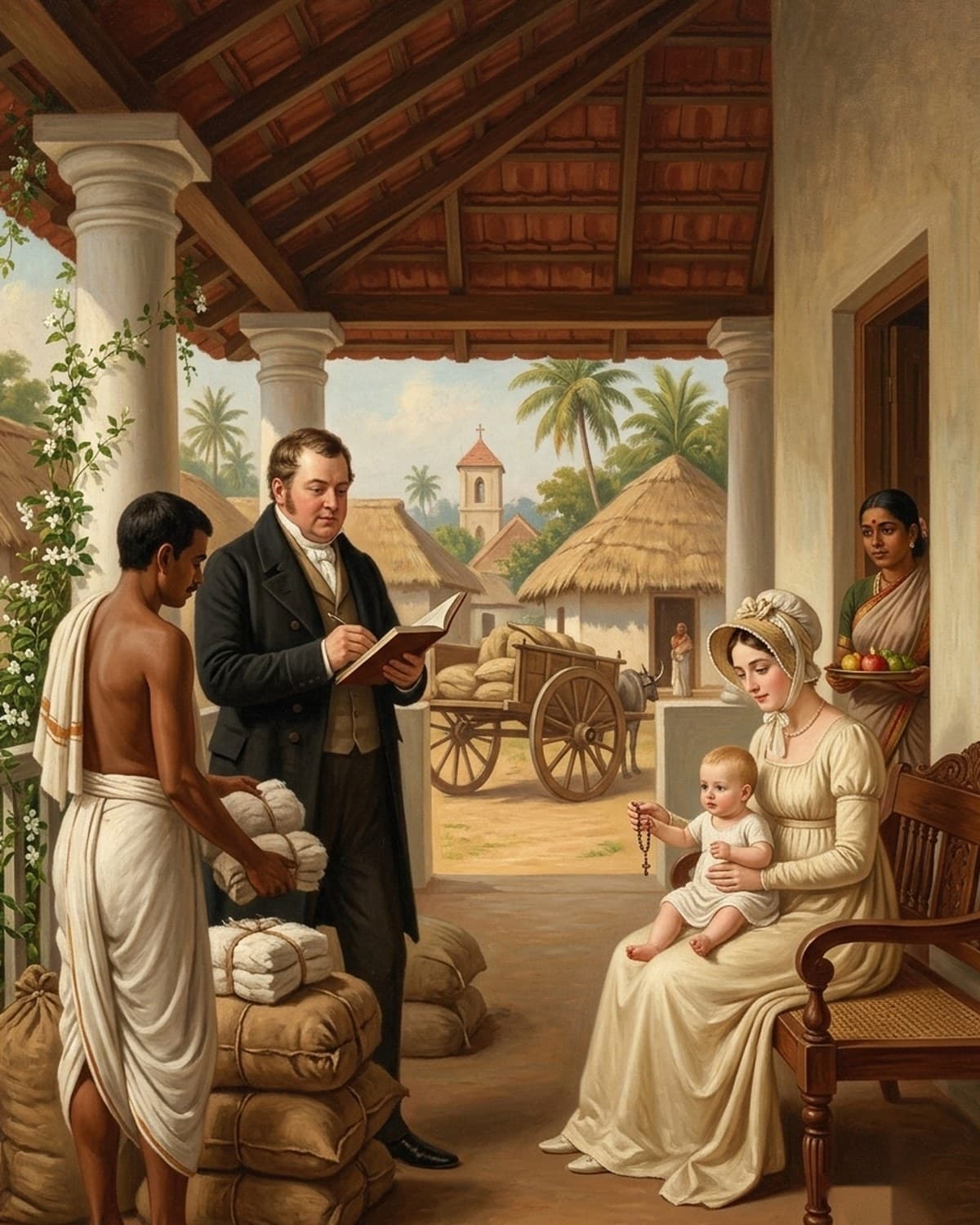
Savarimuthu Pillai, son of Sattiavasagam Pillai, had come up from Tirunelveli to see Mr Bilderbeck, the European settled in this village. He was a visitor. He had no office here, no part in the parish, and no reason at all to be in the church.
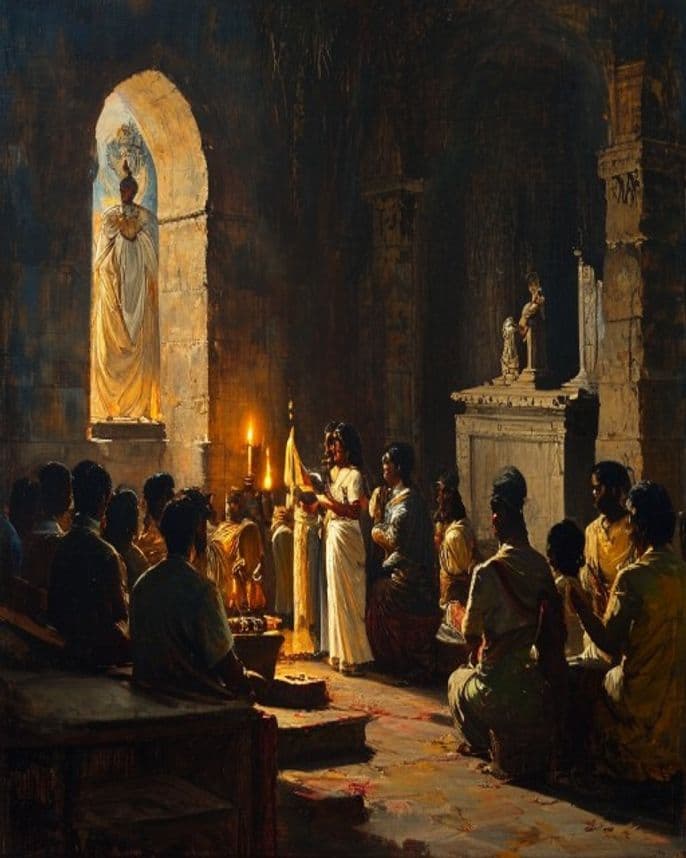
A little after eleven in the morning he went in to pray. The doors of the niche were open “and nothing was hiding the statue of Our Lady”. He knelt down, and began.
“All of a sudden a transparent cloud arose behind Our Lady and wrapped her up; the eyes of the Virgin looked up and filled up with tears; all her face expressed sadness; her joint hands parted and she stretched them out so far as to touch the walls of the recess.” The Tamil telling adds where the tears went: down her cheeks, which it calls coral. And the record does not stop at her — “at the same time all the other statues on the altar expressed compassion and mourning.”
Three things, then. The face clouded over. The eyes filled and the tears ran. The two joined hands came apart and the arms opened until they touched the sides of the niche.
Wherever this account has travelled since — into French in 1905, into English, into Malayalam in 1930 — those three signs travel together, in that order, and no teller has ever added a fourth.
What he did next is the most human thing in the whole record, and it is probably the reason the account survived at all.
He did not run into the street. He assumed he was mistaken. “Fearing to be the victim of a delusion” — the phrase is his historian's — he went out of the church to fetch somebody else, so that another pair of eyes could tell him he was wrong.
In the parish's own typescript of that sentence, a reader long ago struck out the word “virtue” and wrote “victim” above it in ink. The correction is still on the page.
The man he went for was Yagappar Pillai, the catechist — of a family that would serve this church in that office for generations, one of whom was still doing it sixty years later and was given a papal medal for it.
The catechist came in and saw it too, and described it differently. Where Savarimuthu had said a transparent cloud, Yagappar Pillai said he saw the Mother of God wrapped in smoke and in darkness, her face desolate, her arms open, her eyes raised and running with tears.
Two men, ten minutes apart, in the same church, looking at the same thing, and their words do not match. Both descriptions were printed, side by side, by the man who first put this into a book. This page keeps them both. A story in which every witness says the same words is a story somebody has tidied.
Then they sent, in haste, to the house Savarimuthu had come to visit, and the daughter of it ran to the church.
Henrietta Bilderbeck was young and unmarried — both of the earliest printed accounts are careful to call her “Miss” — and she was European and literate, which is why she matters to the record more than devotion alone would make her. She did not simply look. She went up and examined the statue closely, and afterwards she affirmed that the three signs were genuine.
What she described was the least restrained account anyone gave. She saw the eyes “like stars”; the tears breaking from them so abundantly that “they ran to the ground and wetted it”; and the statues of the saints, all together, bowing their heads.
NoteShe is the one witness of that morning who can be found outside this village's own telling. In 1930 a life of St Devasahayam Pillai, printed in Malayalam and belonging to an entirely different devotional tradition, records that “a European woman named Hendrikammal was residing at Vadakkankulam… she came, and saw in the statue the aforesaid three kinds of manifestations.” That book had no reason to know anything about this parish's memory of itself.
The catechist Madurendira Annaviyar took a cloth, climbed up to the altar, and wiped her face.
The tears came again. He wiped again, and they came again, and they neither stopped nor grew less. Somebody lit the candles, and then all of them.
Of everything that is told about that morning, this is the detail nobody has ever left out — not the parish, not the Jesuits, not the Tamil accounts nor the French. A man going up a ladder to dry a face, and failing. It was that, and not the wonder itself, that seems to have broken the people who were watching.
Not the bells that ring here now — those were cast at Valence in France in 1861 and were not hung in these towers until 1872. This was the bell of Fr Buttari's church, the one that a Saivite priest, stopping in the forest to wash before his meal seventy years earlier, had heard through the trees and turned aside to follow.
It rang at an hour at which the bell was never rung, in a village where every person within earshot knew the hours it was rung. They came in from the fields and out of the houses to find out what had happened, and the church filled.
The parish's own Tamil account says they sang the old penitential chant that is sung when a people is afraid — “Parce Domine, parce populo tuo”: spare, O Lord, spare your people — and the Mea culpa, through my fault, through my most grievous fault.
The earliest printed account says something else, and says that every single person who told him about that morning put it in: they beat their breasts, they said “Lord, have mercy on us,” and they recited the Salve Regina.
There is no reason a frightened congregation should not have done all of it. This page prints both and does not put them in an order.
“Whilst they were weeping and praying, the statue of the Virgin and those of the other Saints resumed their customary aspect.” The French account says the same: she came back to her first pose, and all the other images of the saints took on their accustomed look again.
The face above the altar was an ordinary carved face.
Nobody wrote down how long any of it lasted. But it lasted long enough for one man to doubt himself and go and find a catechist; for the catechist to look, and for someone to be sent to a house in the village; for a European household to be roused and its daughter to come and examine the statue; for a man to fetch a ladder and a cloth and climb up and wipe a face more than once; for the candles to be lit; and for a bell to bring a whole village in from its fields.
The first record of that morning was not made by a priest, and it was not written in prose.
It was a song. The village schoolmaster made it immediately afterwards — five stanzas of verse — and he had been in the church and seen the whole of it with his own eyes. He was a worshipper of Siva.
Everything that has been printed since is built on what that man composed on the day: the hour before noon, the open doors of the niche, the cloud that gathered behind her, the tears, the hands reaching out until they touched the walls. When a Jesuit finally set the account down in print a century later, he wrote that he was giving “the substance of the song and its commentary, leaving aside the poetry and the rhythm”.
The story survived. The verse of it did not.
NoteA second account, in prose, followed the song and — in the words of the man who read them both — “reproduces the first exactly, paraphrases and completes it”. It was written by Ko. Sebastian Pillai, who never claims to have been present. The song came first, and no copy of it is known to exist anywhere.
The Bilderbecks were flesh and blood and they can be named.
Christopher Bilderbeck, born about 1758, was a merchant of European descent who settled at Vadakkankulam late in the eighteenth century and died here in 1817. They were people of standing: the family held the revenue-farm of Nangunery, which is to say they collected the dues of a whole tract of country. Henrietta, who examined the statue that morning, was his daughter.
A son, John, was born to the house in 1809, six years after the weeping. When John died in 1880, an English Protestant missionary journal recorded of him that he had been “born in India… of a Roman Catholic family, and trained for the priesthood of that Church”, and a Methodist directory supplies his birth year.
So the family that stood in this church on that Friday left a paper trail of its own — in Protestant hands, kept by people with no reason on earth to flatter a Catholic shrine.
This part belongs to the village, and it is told here as the village tells it.
Christopher Bilderbeck and his wife had been married twenty-seven years without a child. He was past fifty by then, which is the age at which a man stops asking. They asked anyway: they prayed to Our Lady of this church, and before the year was out a son was born to them.
What they gave afterwards, they gave in thanksgiving.
NoteNo source outside this parish records the prayer or the promise, and no source anywhere gives a figure for what was given. It is kept on this page because it is what the village has always said, and it is marked as tradition for the same reason.
When the Society of Jesus came back into this mission in 1838, thirty-five years had gone by. Many of the people who had been in the church that morning were alive, and could be asked.
The first fathers to reach Vadakkankulam found themselves, as one of their own afterwards put it, “as if wrapped and steeped in the powerful atmosphere of that tradition”. They had only to listen to what the village willingly told them, and in listening they became witnesses in their turn.
And there was one thing the village always put in, which nobody who told the story ever left out: how the church had filled and the many candles of the altar were lit and everyone was on their knees, and how someone went up to wipe the tears and could not stop them or make them less.
In 1903 the parish kept the centenary. It was folded into the great August feast rather than given a day of its own, and it fell on the fifteenth of August, the Assumption — the title under which the statue has always been venerated here.
The Bishop of Trichinopoly authorised it. Six priests were present. A new bell-tower had lately been raised. And the Mother was carried through the streets of the village, in the words of the man who printed the account two years later, “to the sound of the bells and the tam-tams”.
A hundred years, and a village that had counted every one of them.
Somewhere near that centenary a Jesuit of this mission came to see the thing for himself, and he is the only person on record who ever laid hands on the statue to test it.
The village had made a working copy: a hollow imitation with wires and rods inside, so that one pull raised the head, lifted the eyes to heaven, parted the hands and opened the arms, and a second pull put everything back. “They kindly re-did the miracle for us,” he wrote — drily, because it did not go smoothly, and the man working the strings tangled them more than once.
Then he went to the statue itself, standing alone in its place of honour above the tabernacle, and put his own hands on it. He tried to straighten the head. He tried to lift the eyelids and roll the eyes. Above all he tried to separate those two hands carved from a single piece, and to force the rigid arms apart.
Wasted labour, he wrote. It was the dead resistance of raw matter, of a dried tree-trunk. And then he gave up what he called his usurped office of inquisitor of the Faith — gave it up gladly, he says — and knelt down.
NoteHe was a Jesuit of this mission and openly devout, and the page says so rather than presenting him as a neutral examiner. What his account establishes is not the miracle: it is what a named man did with his hands in about 1905, and what he found when he did it.
For a long time it was thought that everything known about that Friday came down a single line — Léon Besse's La Mission du Maduré, printed at Trichinopoly in 1914, four copies of which are known to exist and none of which had been opened.
It does not. Nine years before Besse, a Jesuit of this mission had already printed the full account, in French, in 1905; that volume is on this parish's own shelf and its pages have been read. Besse's own text has since been read too, in the English typescript the parish holds. And in 1930 a life of St Devasahayam Pillai, written in Malayalam and belonging to another tradition altogether, recorded the same European woman examining the same three signs.
Three hands, none of them copying the others.
One thing is still missing, and this page would rather say so than pretend otherwise. In a footnote on his own page about this miracle, Besse writes that he is abbreviating, and points his readers to a fuller discussion in the mission's bulletin, La Gerbe du Maduré, for July–August 1911. That issue sits in a Jesuit archive in France. It has never been digitised, and nobody working on this parish's history has read it. The fullest account of this morning has been sitting unread for a hundred and fifteen years.
A shrine that asserts a miracle has given the argument away. So here is the same story again, sorted by how strong the evidence for each part of it actually is — including the parts where this parish's own sources contradict each other.
Documented
That it was told, that day, by those people
This is the strong part, and it is stronger than most parish miracles anywhere. The witnesses are named, with patronymics, with the town one of them travelled from and the household he was visiting. The first account was made on the day itself by an eyewitness who was not a Christian. Three unconnected printed sources carry it — a French one of 1905, an English typescript of Besse's history, and a Malayalam one of 1930 — and they agree on the witness, the household, the catechist, the day, the hour and the centenary without having copied one another.
Documented
The day
Every source in every language gives the same Tamil date: the seventh of Aippasi, in the year 979, a Friday. The twenty-first of October 1803 was a Friday; the twenty-third was a Sunday. The diocese keeps the commemoration on the twenty-third, and the parish's 150-year souvenir once printed 1805 — a copying slip for 1803, which is corrected here rather than hidden. The year is not in doubt: the parish's own roll of priests puts Fr John Louis Cardoza in office in exactly 1803, and the centenary was kept in 1903.
Devotion
The weeping itself
Nobody photographed it. No commission examined it. The only man who ever tested the statue did so about a hundred years afterwards, and what he established was that its hands do not move, not that they once did. What exists is what the witnesses said, written down the same day, repeated to the returning Jesuits by people who had been in the church, printed three times in three languages, and kept as a feast for two hundred and twenty-three years. That is a devotion with an unusually good paper trail. It is not a proof, and this page does not offer it as one.
Documented
What was never done
This was never carried to Rome. There has been no canonical investigation and no decree; it appears in none of the standard registers of Marian apparitions. It is a local and diocesan devotion, and the parish has never claimed anything more. There is a live disagreement inside the record about the day itself, and both halves belong here: the parish remembers that the priest of that year, Fr John Louis Cardoza, examined the statue and declared the wonder genuine on the spot. The earliest printed account says the opposite — that the Goa priest who administered this village was not there when it happened and did not normally live here, that the see of Cochin stood vacant, and that no approving ecclesiastical document exists. Both readings are printed. Neither is deleted. That is this parish's rule for conflicting sources, and this is the page on which you can watch it being kept.
Parish tradition
Where the statue came from
The box marked “To Vadakankulam, From Portugal” is the parish's own memory and appears in no printed source before the parish's modern chronology. The fullest description of the statue ever printed, made in 1905 by a man who handled it, says instead that it is the work of a local craftsman in local wood. Both are on this page. What is certain about the statue is not where it came from but what it is: an image whose hands are joined and carved from one piece, which is exactly what the witnesses of 1803 said they saw come apart.
None of this is offered as proof. It is offered as a record — what people said, who they were, when it was written down, and what has never been established. Make of it what you will, which is what this village has been doing since 1803.
Since that morning
What the parish does with it now
The statue is still here, in a shrine of her own beside the great church, and the village has not missed an anniversary.
Where she is
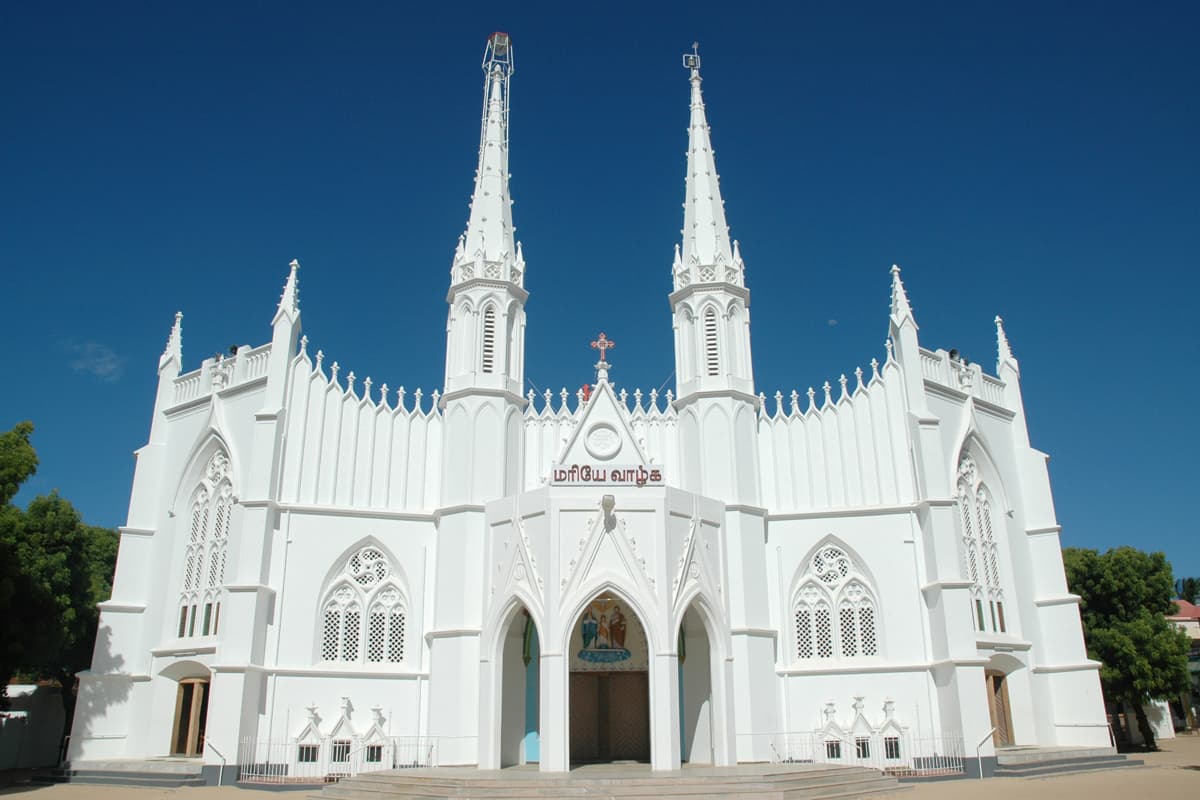
The statue stands in the Apparition Shrine — Matha Kaatchi Aalayam, the shrine of the Mother's vision — built beside the two-nave church. She is vested and crowned for the feasts. You can walk up to her.
The October commemoration
The parish keeps the anniversary of the apparition every October, with a special adoration in the evening. It is one of the two great observances of the year here; the other is the ten-day Assumption feast of 6–15 August, when something close to a hundred thousand people walk behind her chariot.
The first Saturday
On the first Saturday of every month there is the novena to Our Lady and adoration of the Blessed Sacrament. It is the quietest way to see this shrine, and the way the people of the village themselves keep it.
This page is built from J.-B. Dessal, S.J., “Vadakencoulam: son histoire, sa merveille, son jubilé”, printed in the Lettres de Gemert in 1905 — the earliest known printed account, written by a Jesuit of this mission while the grandchildren of the 1803 generation were still living; from Léon Besse's La Mission du Maduré (1914), read in the English typescript the parish itself holds, page 842; from a Malayalam life of St Devasahayam Pillai printed in 1930; from the Protestant records of the Bilderbeck family; and from the parish's and the diocese's own accounts. Each chapter above names the witnesses it rests on, and every one of them is listed in full on the Sources page.